Wine Making from Kit: Buyer's Checklist

What a wine kit actually is
A wine kit is a boxed set of prepared juice or concentrate, a yeast packet, and the additives the producer thinks you need to turn that juice into a stable homemade wine. It is not a miniature commercial winery, and it is not a pass that lets you skip sanitation or patience. It is a way to start with a known volume of juice instead of crushing fruit on the kitchen floor.
The most stubborn myth around wine making from a kit is that the result is "not real wine." Wine is fermented fruit. A kit is still fruit, usually grape, sometimes another fruit, that has already been processed so you can work in a small kitchen. The quality of the glass depends on the quality of that juice, how clean your vessels are, and whether you follow the timing in the booklet instead of the timing in a forum thread.
What a kit does not do is put you outside the law. You are still making wine at home for personal or family use, and the federal household caps still apply. State and local rules can be stricter. Read those before you put a pail on the counter.
What you should find in the box, and what you usually will not
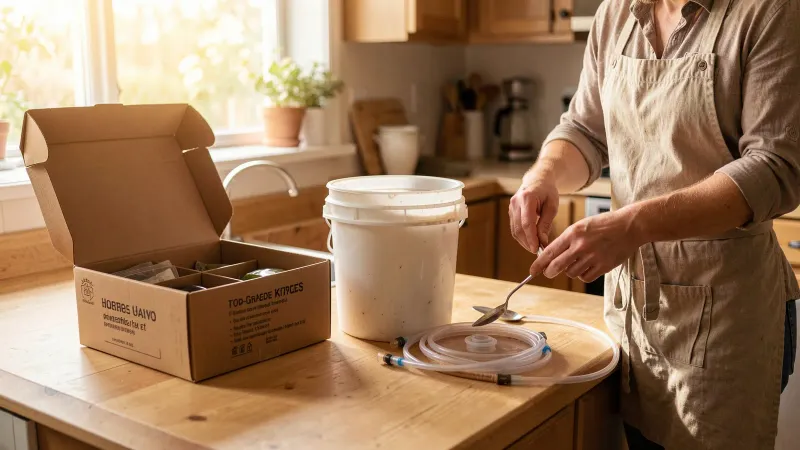
Kit producers do not all pack the same thing. Read the contents list, not only the photo of a filled glass. A typical ingredient kit includes a bladder or pail of grape concentrate or prepared juice, a wine yeast packet, one or more fining agents, and a timed set of additives for later stages. Some boxes add oak chips or a small bag of grape skins. Some include a short booklet with a calendar. A "complete" kit may also include a bucket, a lid, an airlock, and a stirring spoon. Many do not include bottles, a hydrometer, or a sanitizer, even when the front of the box looks fully equipped.
Use this map as a starting point, not as a laboratory ranking of brands. You will see trade names such as Winexpert, Vineco, and similar shop labels. Treat the name as a label. Compare what is actually in the carton.
| What the box claims | What to verify before you pay | What you may still need to buy |
|---|---|---|
| Ingredient kit, often 5 or 6 gallons finished | Juice or concentrate volume, style, and the date printed on the package | Primary fermenter, carboy, airlock, hydrometer, siphon, sanitizer, bottles |
| "Complete" or equipment-included kit | Which vessels are included, and whether they match the finished volume | Bottles, corks or caps, a corker, a hydrometer if it is missing |
| Small 1-gallon starter kit | Whether the yeast and additives are dosed for that small volume | A 1-gallon jug, a bung and airlock, a way to take gravity |
| "Premium" or longer-aging kit | Whether you get more juice and less dilution, skins, or oak, and a stated aging window | Time and storage space; these kits are not faster, they are slower |
| Fruit wine kit | Which fruit, and whether the kit expects you to add water or extra sugar | The same basic vessels; follow the booklet, do not borrow a grape schedule |
If the carton has been sitting in a hot shop window, walk away. Concentrate and yeast both suffer in heat. A kit is a food product with a date on it.
Myths that make a first kit harder than it needs to be
Myth one: a more expensive kit is automatically a better wine. Sometimes you are paying for more juice and less water, or for oak and skins. Sometimes you are paying for packaging and a heavier bottle photo. Compare the contents list.
Myth two: you should add extra sugar "to make it stronger." A kit is built around a particular starting sugar level and a particular yeast. Changing the sugar changes the balance the booklet was written for, and it can leave you with a ferment that struggles to finish. If you want a different style, buy a kit made for that style.
Myth three: a busy airlock means the wine is fine, and a quiet one means it is dead. Airlocks leak. A ferment can move with only a lazy bubble. A hydrometer tells you whether sugar is still falling. The booklet's gravity targets matter more than the sound of the airlock.
Myth four: you can ignore the kit yeast and pitch whatever is in the drawer. If the packet in the box is in date and has been stored cool, use it. Kits are built around a particular strain. Swapping without a reason is how a batch ends up smelling like a different wine than the one on the label.
A buyer's checklist for wine making from a kit
Print this, or copy it onto a card, and fill it in before you open the yeast.
- You have checked federal household limits and any stricter state or local rule that applies where you live
- This batch, plus wine already made this calendar year, will stay under the household cap
- The wine will be for personal or family use and will not be sold or offered for sale
- The kit is in date and has not been stored in heat
- You know the finished volume and have a vessel that actually holds it, with headspace
- You have read the contents list and know whether equipment is included
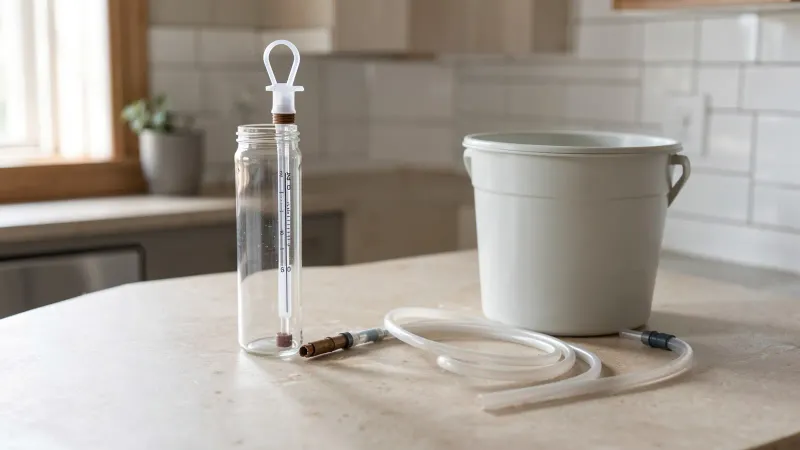
- You have sanitizer, a hydrometer, and a siphon if the box does not include them
- You have a place the ferment can sit undisturbed, out of direct sun, in a reasonably steady temperature
- You have read the whole booklet once before you mix anything
- You have a plan for bottles, closures, and a label that is for your own cellar, not for a shop shelf
If any line fails, delay the purchase or delay the start. A kit is cheaper than a spoiled pail.
A working sequence once the box is on the table
This is not a substitute for the booklet that came with the kit. Kits do not all share the same number of days, and inventing a universal calendar is how people rack too early or bottle too soon.
Read the instructions from start to finish. Clean and sanitize every vessel, spoon, and hose that will touch the juice. Mix the juice or concentrate as the booklet directs, including any water the kit is designed to receive. Take a starting specific gravity and write it down, with the date. Pitch the yeast the way the packet and the booklet describe, and keep the vessel under an airlock once fermentation is underway.
Hold the temperature inside the range the yeast can work in. Do not chase a faster ferment by moving the pail to a radiator. When the booklet tells you to rack, take another gravity reading first. Bottle only when the kit's process says the wine is ready to be stable, and the gravity has stopped moving. If a later step includes a sulfite or sorbate addition, use the dose in the booklet for that batch size. Do not guess a dose from memory.
If you want a longer walk through yeast itself, including nutrient and rehydration, that is a separate question from choosing the kit. Use the yeast that came in the box unless it is past its date or was stored hot.
Federal rules that still apply to a boxed kit
Choosing a kit does not change the legal category of the batch. Under federal rules administered by the Alcohol and Tobacco Tax and Trade Bureau, an adult may produce wine for personal or family use, and not for sale, without paying federal excise tax, up to a household cap. The cap is 100 gallons per calendar year if one adult lives in the household, or 200 gallons if two or more adults live there. For this rule, an adult is 18 or older, unless a stricter local age for buying wine applies, in which case that higher age is the one that counts.
The wine may be taken off the premises for personal or family use, including a home-winemaker contest or tasting. It may not be sold or offered for sale under any circumstances. State and local law can be stricter than the federal exemption, and the federal rule does not authorize a batch that breaks those laws. The official text is in 27 CFR 24.75, and the bureau also explains home production in its Wine FAQs.
A six-gallon kit counts as six gallons toward the cap when you produce it, not as zero because it came from a shop. Keep a simple running total for the calendar year.
Questions about wine making from a kit
Is wine making from a kit easier than starting with fresh grapes?
It is usually less messy, and the starting juice is more predictable. You still have to sanitize, take gravity readings, and wait. Fresh grapes ask you to crush, press, and manage skins. A kit asks you to follow a booklet. Neither path is automatic.
Can I split a six-gallon kit into smaller jugs to make it more manageable?
Only if you can divide every additive in the same proportion and still measure accurately. Many people try this and end up with one jug that is over-dosed and one that is under-dosed. If you want a smaller batch, buy a kit that is sold at that volume.
What if the yeast packet in the kit is past its date?
Do not pitch tired yeast into a full pail and hope. Buy a fresh packet of a wine yeast the producer recommends for that style, or contact the kit maker for the intended strain. Keep kits out of heat so this problem is less common.
Does a kit batch count toward the federal household gallon limit?
Yes. The limit applies to wine you produce in the household during the calendar year, not to wine you produce only from fresh fruit. Record the finished volume and keep the running total under the cap that applies to your household.