Home Brew Wine Making Kit: How to Choose
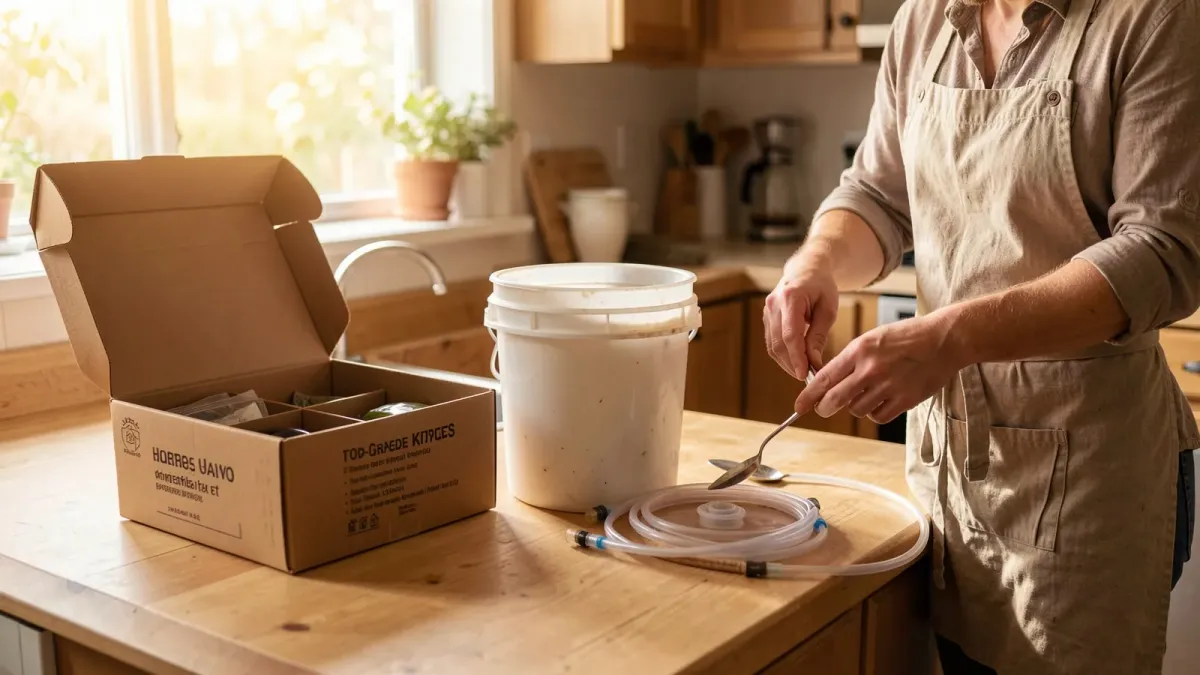
A home brew wine making kit is a product, not a personality test
Home-brew shops sell beer kits and wine kits on neighboring shelves, and the phrase home brew wine making kit mixes those aisles in a search box. What you are choosing is still a boxed wine: a measured juice or concentrate, a yeast, and a set of timed additives, sometimes with a bucket included. You are not choosing a lifestyle, and you are not choosing a commercial winery in a carton.
The useful comparison is between kits that will actually fit your kitchen, your patience, and your household legal limits. The less useful comparison is between front-label scores, "reserve" badges, and whatever a stranger claimed about a brand on a forum. You will see names such as Winexpert, Vineco, and similar shop brands. Treat them as labels. Open the contents list and compare the same few facts each time.
A second confusion is worth clearing up early. A wine kit is not a still, and it is not a path into homemade spirits. Federal law treats homemade wine and homemade distilled spirits very differently. If a listing tries to sell you a "moonshine kit" as if it were the same hobby, walk away from that listing and stay with wine.
The real differences between kits, side by side
When you compare a home wine making kit with a home brew wine kit, or two wine kits with each other, look at these rows. They matter more than the photograph of the glass.
| Choice | What varies | What to prefer for a first kit | What to be careful about |
|---|---|---|---|
| Ingredient kit versus complete kit | Whether the box includes a fermenter, lid, airlock, and spoon | Either can work; a complete kit is handy only if the vessels are the right size and food-grade | A complete kit that still omits a hydrometer, sanitizer, and bottles is not complete |
| Finished volume | Often about 1 gallon, or 5 to 6 gallons | A volume you can lift, store, and actually drink | A six-gallon kit in a five-gallon bucket, or a tiny kit whose additives are hard to split later |
| Grape style versus fruit style | Red, white, rosé, or a named fruit | A style you already like to drink | Buying a dessert kit because it sounded fancy, then wishing it were a dry table wine |
| Standard versus longer-aging kit | Juice quality, skins or oak, and the stated time in the cellar | A standard kit if you want a sooner first bottled wine | Paying for a long-aging kit and then opening it in a month |
| Freshness and storage | Date on the package, and how the shop stored it | A kit that is in date and has been kept cool and out of a window | A faded box from a warm shelf, even if the price looks kind |
| Add-on packs | Extra oak, skins, or a second yeast | Only if you know why that pack is there | Stacking extras on top of a kit that is already complete |
A "home brew wine kit" sold next to beer gear should still be judged as wine. Beer buckets and wine carboys can share a sanitizer and a siphon. They should not share a yeast packet or a calendar. Follow the wine booklet for the wine kit.
How to choose without running a laboratory test
You cannot taste the finished bottle in the shop, and you should not pretend a blog ranking is a lab result. You can still choose well.
Start with the style you like in a glass. If you drink dry red wine, do not buy a sweet fruit kit because it was on offer. Then check volume. A one-gallon home wine making kit is a sensible first try if you are short on space. A five- or six-gallon kit is more economical per glass only if you will store and drink that much.
Read the contents. If the kit is a complete equipment bundle, inspect the bucket size, the quality of the lid, and whether an airlock and bung are actually in the box. If it is an ingredient kit, confirm that you already have, or will buy, a food-grade fermenter, a carboy, a hydrometer, a siphon, a sanitizer, and bottles.
Check the date. Concentrates and yeast are food products. A discounted kit that has baked in a warehouse is not a bargain. If you buy online, have a plan for where the box will sit if the parcel arrives on a hot day.
Ignore the urge to "upgrade" the kit in the cart with extra sugar, a second yeast, and a large bag of oak. Choose the kit that already matches the wine you want. You can always buy a different kit next time, and you will learn more from one kit followed as written than from one kit rewritten on the kitchen counter.
A short choosing checklist
- You want homemade wine, not a still or a spirits project
- The style on the box is a style you actually drink
- The finished volume fits your vessels, your storage, and the household gallon cap
- You have compared an ingredient kit with a complete kit and know what is missing from each
- The package is in date and does not look heat-damaged
- You have a hydrometer and sanitizer, even if the kit is sold as complete
- You will follow the booklet rather than adding a second set of additives in the shop
- The wine will be for personal or family use and will not be sold
- State and local rules, as well as federal rules, allow the batch you are planning
If you cannot tick the legal lines, do not buy the kit. If you cannot tick the equipment lines, buy the missing supplies first, or choose a complete kit that truly includes them.
After you choose, resist the urge to rewrite the box
A home brew wine making kit is designed as a set. The yeast, the nutrient, the fining agents, and the later sulfite or sorbate steps are meant to work with that juice at that volume. The most common way to turn a decent kit into a confusing batch is to treat the box as a suggestion.
Use the yeast in the kit if it is in date. Use the water amount the booklet names, if water is required. Take a starting gravity so you have a record. Hold a steady temperature. Bottle when the process and the gravity say the wine is ready, not when you are simply tired of looking at the carboy.
If the first kit turns out well, choose the next one by a single change: a different grape style, a longer-aging kit, or a fruit kit, not five changes at once. That is how you learn what you like, instead of guessing.
The legal line that a kit does not cross
A kit is a convenient way to make wine at home. It is not a permit to sell that wine, and it does not change the household cap. Under federal rules administered by the Alcohol and Tobacco Tax and Trade Bureau, an adult may produce wine for personal or family use, and not for sale, without paying federal excise tax, up to 100 gallons per calendar year if one adult lives in the household, or 200 gallons if two or more adults live there. For this rule, an adult is 18 or older, unless a stricter local age for buying wine applies.
The wine may be removed for personal or family use, including a contest or tasting, and it may not be sold or offered for sale. State and local law can be stricter. The official text is in 27 CFR 24.75, and the bureau also explains home production in its Wine FAQs.
If you are choosing between a wine kit and any product aimed at distilling spirits at home, the legal difference is not a technicality. Federal law allows limited homemade wine and beer for personal or family use. It does not give a similar personal-use exemption for distilled spirits. Stay with wine if you are working in a household kitchen.
Questions to ask before you choose the kit
Is a home brew wine making kit the same thing as a beer kit with different yeast?
No. The vessels and the sanitizer can be shared, but the juice, the yeast, the additives, and the calendar are not interchangeable. Buy a wine kit for wine, and follow the wine instructions.
Should I buy a complete equipment kit or only the ingredients?
Buy a complete kit if you do not yet own food-grade vessels of the right size and the included equipment is genuinely that. Buy an ingredient kit if you already have the core supplies, or if the complete bundle looks cheap because the bucket is too small. In both cases, plan to own a hydrometer and a sanitizer.
Are "premium" or "reserve" home wine kits worth the extra money?
They can be, if the extra money buys more juice, skins, oak, or a style you will actually wait for. They are not worth it if you only want a first practice batch, or if you will open the bottles long before the stated aging window. Read the contents and the timing, not only the badge on the front.
Can I legally sell bottles from a home brew wine kit if friends ask to buy them?
No. Wine produced under the household exemption may not be sold or offered for sale, including informal sales to friends. If you want to sell wine, you are in a different legal category, with federal and state qualifications that a kitchen kit does not provide.